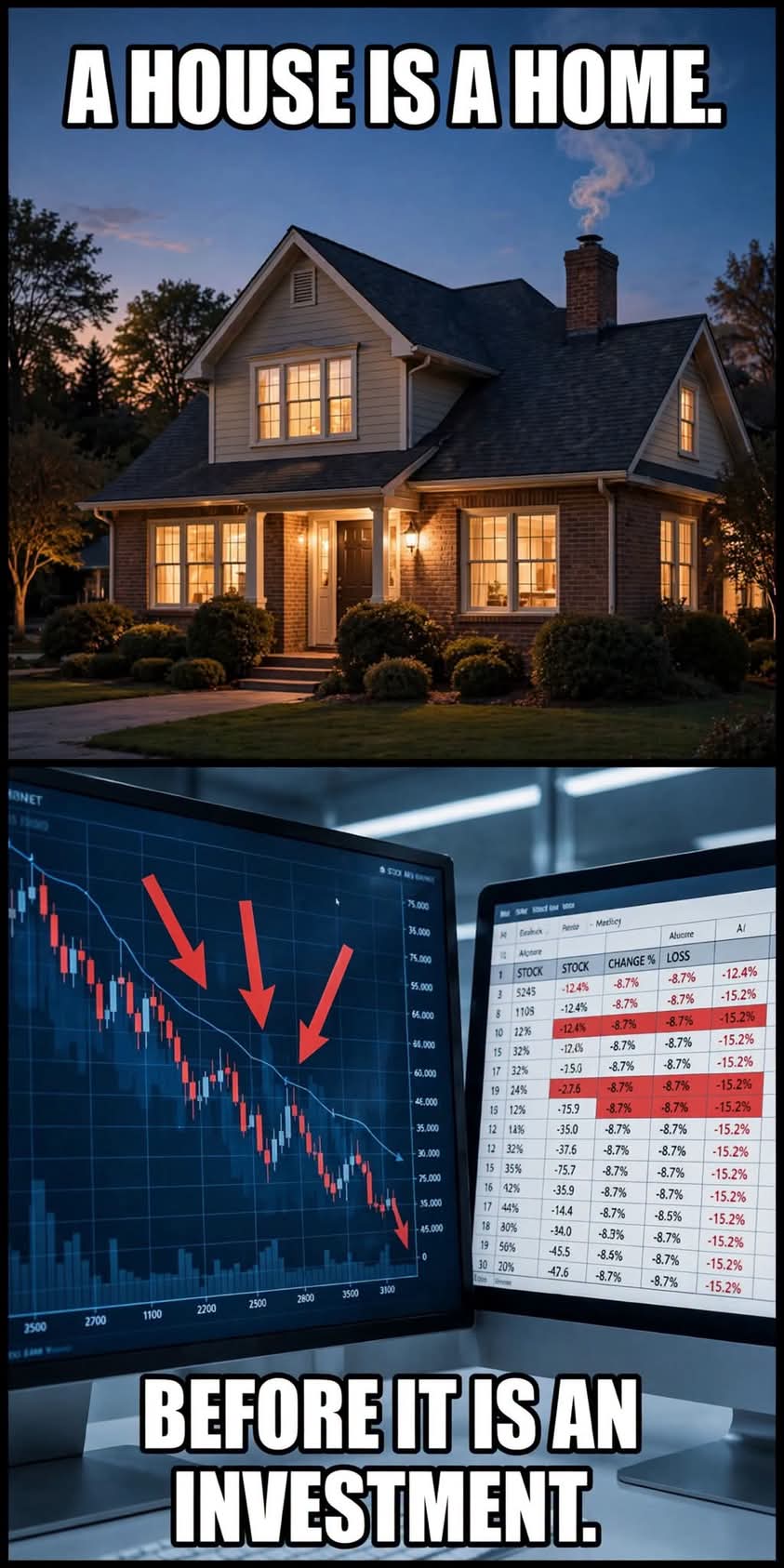
Housing Is a Home;
Before It Is an Investment.
by Carl Gottstein

Have you seen the price of renting or buying a home lately? It’s way out of kilter, the prices simply do not match the incomes of ordinary people, it’s like people are now “slaving” for want of a better word, just to keep a roof over your heads. I bought my fixer upper two family home for 85k in 2006. They just doubled my assessment. It’s a reflection of the hyper inflation housing prices.
In case you think that makes me a big winner, it doesn’t.
I’m not selling my house, ever.
It’s just a handy excuse to raise my property taxes. Democrats don’t need an excuse, but they love to point at their latest value chart to excuse their taxation outrages. But that’s another story, back to the housing crisis.
-Drive down any street at dusk and watch the windows light up, one by one. Behind every one of them, somebody’s life is happening — dinner on the stove, homework spread across the kitchen table, an old dog asleep by the door.
That’s what a house is, before it’s anything else.
We need to have an honest conversation about housing speculation.
A house is not just another commodity. It is not a stock certificate, a cryptocurrency, or a luxury collectible to be bought, held, flipped, and traded with little thought for the people caught in the middle.
A home is where people sleep at night. It is where children do homework, where families recover from illness, where seniors age in place with dignity, and where the people who keep a town running begin and end every day — the nurse coming off a night shift, the mechanic, the teacher grading papers at the kitchen table.
That is why I believe housing speculation should be minimized — not because people should be forbidden from owning property or earning a reasonable return, but because housing is a human necessity before it is a financial asset.
There is a real difference between investment and speculation.
Investment can be productive.
A person who buys a neglected house, repairs it, brings it up to code, and provides a safe long-term rental is contributing something of value. A developer who builds apartments, starter homes, or affordable housing is adding supply. A local landlord who maintains the property and treats tenants fairly serves an important role in a community.
And here’s an honest complication worth naming: the line between the two isn’t always bright. A landlord who buys a building, never fixes the furnace, and raises the rent every year isn’t investing in housing — he’s speculating on people’s need for shelter. The test isn’t what you call yourself. It’s what the property, and the neighborhood, look like after you’ve owned it a while.
Speculation is different from investment.
Speculation is buying homes mainly because prices are expected to rise — not because the buyer plans to live there, improve it meaningfully, or make it available to a family at a reasonable cost. It is buying up entry-level homes in bulk, leaving units empty, converting whole neighborhoods into short-term rentals, or flipping houses fast simply because scarcity pays.
When investors compete with working families for homes that are already in short supply, the result is predictable: prices rise, rents follow, and ordinary people get pushed further from ownership and stability.
That may look like success on a spreadsheet.
But it is not success for a community.
Now, a word for the folks reading this who already own a home and feel a knot in your stomach. If your house gained value over twenty years of mortgage payments and maintenance, nobody’s coming for that. For most working families, the home is the savings account — the retirement plan, the thing you hope to hand your kids. That’s not speculation. That’s exactly what ownership is supposed to be. The problem was never your equity. The problem is a market where the next young family can’t get a foot on the first rung of the ladder you climbed.
A society cannot claim to value work, family, responsibility, and upward mobility while letting housing drift out of reach for the people who do the work that keeps communities functioning.
Teachers, nurses, mechanics, retail workers, first responders, restaurant employees, tradespeople, young families — they should not be priced out of the places they serve.
The problem is not that someone owns a second property.
The problem is when homes are treated as financial instruments first and shelter second.
And here’s the part we don’t say often enough: speculation is most profitable where housing is scarcest — and scarcity is often a choice. When it becomes nearly impossible to build, every existing home turns into a lottery ticket, and speculators are simply the people best positioned to cash in. If we want speculation to wither, the single most powerful thing we can do is build enough homes that nobody can get rich just by sitting on one.
We should reward the kinds of investment that actually help communities:
- Building more housing.
- Restoring abandoned or unsafe properties.
- Creating well-maintained long-term rentals.
- Supporting first-time buyers.
- Expanding affordable and workforce housing.
- Encouraging local ownership and responsible property management.
At the same time, we should discourage the practices that profit from shortage and displacement: - Leaving homes vacant just to wait for values to rise.
- Bulk-buying starter homes in communities where residents can’t compete.
- Flipping properties without making real improvements.
- Turning residential neighborhoods into permanent short-term-rental zones.
- Letting distant corporate owners neglect properties while extracting ever-higher rents.
One more thing, and it matters: all of this has to be done constitutionally. The right to private property is protected — the government can’t seize homes or rewrite the rules retroactively to punish people who bought within the law.
That’s as it should be.
So the tools we reach for must be the lawful ones: zoning that allows building, tax policy that rewards productive use over vacancy, incentives for first-time buyers, real support for affordable housing. We don’t need to take anyone’s property.
We need to stop making housing scarcity so profitable.
There is no single solution.
We need more housing construction, smarter zoning, real support for affordable housing, protections for tenants, and policies that make it harder to profit simply by sitting on scarce homes.
But we also need to change the way we talk about it.
Rising home prices are treated as automatically good news.
They’re good news for people who already own and plan to sell or borrow against the equity.
For renters, first-time buyers, young adults, and families trying to put down roots, relentlessly rising prices can mean the door to stability is quietly closing — not with a slam, but a little more each year, until one day a young couple does the math and realizes the town they grew up in has no room for them.
Housing should create communities — not merely portfolios.
Private property matters.
Investment matters.
Economic growth matters.
But a decent society has to recognize that there are some things are too essential to be governed only by the logic of maximum profit.
A home should first be a place for someone to live.
Human beings & shelter.
❤️-C